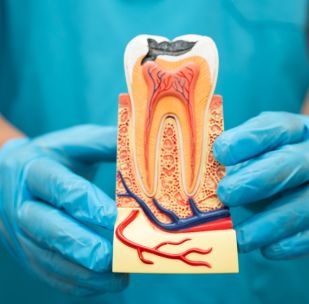
Some indications that you may have an infected tooth are:
- Severe pain when biting down
- Sensitivity to hot and cold temperature
- Swelling or tenderness of gums
- Darkening or discoloration of the tooth
 A pimple or raised bump on the gums
If you notice any of these symptoms, please call Evolve Dental Care, so we can see you as soon as possible to find out what’s happening.
How stressful is a root canal?
You’ve heard the stories, and now that your dentist told you that you need a root canal, you wonder if the procedure is as stressful as friends say it is.
Many decades ago when dentists performed root canals, they were limited to the instruments and techniques that were available at the time. This often resulted in a lengthy procedure that was not all that comfortable.
Recognizing that this was not what they wanted for their patients, dentists set out to do everything possible to improve the experience.
Digital x-rays produce images that allow us to precisely plan the procedure, so it is as efficient as possible. Dentists like Dr. Amir and Dr. Sunny pursue advanced training in endodontics to ensure that you receive the most updated care available. We also use the latest in long-lasting anesthetics to ensure that you’re entirely numb throughout your procedure. For even greater comfort, we offer nitrous oxide sedation at our Emmaus, PA dental office to help you relax.
What happens during a root canal?
When you arrive at Evolve Dental Care for your appointment, we will help you get settled comfortably in your dental chair. Next, we will numb your mouth with a local anesthetic so you won’t feel any pain.
When we’re confident that you’re numb, Dr. Amir or Dr. Sunny starts the procedure by making a small access hole in your tooth. We use specialized instruments to remove the infected tissue from the interior of the tooth. It’s essential to take our time with this step to ensure that we remove every trace of infection.
Next, we carefully clean, disinfect, and seal the opening. It may be possible to place a filling on the tooth after a root canal, but in most cases, we’ll recommend a dental crown to protect and strengthen it. After restoration, your tooth will function just like any other tooth.