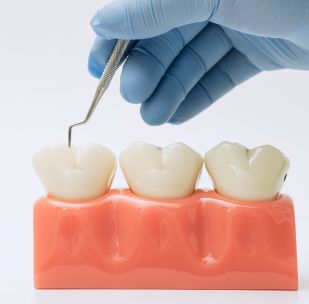
Periodontal Treatment
Stay a Step Ahead of Gum Disease

Our periodontal deep cleaning treatments in Allentown are designed to remove the infection and restore the health of your gums.

young family of three hugging | periodontal treatment allentown

Periodontal Treatment in Allentown, PA

middle-aged couple smiling on couch l periodontal treatment allentownDid you know that periodontal disease affects one out of every two American adults age 30 and over? Periodontal (gum) disease is a chronic bacterial infection that attacks gum tissue and the bone that supports your teeth. If we don’t find and treat gum disease in its earliest stages, it can eventually lead to tooth loss and other serious health problems.

If your gums bleed when you brush,or you find that bad breath lingers long after you’ve rinsed with mouthwash, you are probably seeing symptoms of periodontal disease. Bad breath and bleeding gums are just a few of the symptoms of periodontal disease (also known as gum disease).

Gum Disease – A Hidden Threat

At Evolve Dental Care, we take the treatment of periodontal disease very seriously. You see, it’s not just a problem that affects the health of your teeth and gums. Recent studies have shown that, without preventive treatments and proper hygiene practices, the bacteria present with severe gum disease can enter the bloodstream. These bacteria have been linked to serious health complications like heart disease, respiratory disease, diabetes, and stroke.

Prevention is the key to avoiding gum disease. With regular dental visits and conscientious at-home oral hygiene, you may never have to worry about developing periodontal disease at all.

Treating Periodontal Disease in Allentown, PA

In general, we can treat a minor case of periodontal disease during a routine dental cleaning. However, if we find that your periodontal infection is more advanced, a deep cleaning will be necessary to eliminate the bacteria and infected tissue.

Deep cleaning involves removing plaque, tartar, and harmful bacteria from your teeth and gums. The purpose of the deep cleaning is to remove infection and promote healing of gum tissue. If necessary, we may prescribe antibiotics to make sure that we eliminate the infection completely.

A gingivectomy is a procedure that’s necessary when advanced gum disease has opened pockets between the teeth and gums. These pockets may be difficult to clean properly with a traditional scaling and root planing treatment by our hygienist, and a gingivectomy may be required to remove bacteria completely. This deep cleaning treatment can be uncomfortable for some, but our soft tissue laser has proven to be a very effective alternative, with minimal discomfort, bleeding, and recovery time.

Fluoride varnish treatments are highly recommended as a preventive measure for adults ages 65 and over. If you’re an older adult who has been treated for gum disease, your dentist may have reshaped your gums. This process exposes tooth roots, which also can lead to decay. To protect your teeth's roots, we suggest a fluoride varnish or gel. 

Protect Your Oral Health with Evolve Dental Care

Are you noticing symptoms that you think may be related to gum disease? If so, we encourage you to call our Allentown dental office to arrange an appointment for a professional cleaning with our dental hygienist. We’ll evaluate your situation and develop a plan for treatment that will get your periodontal disease under control and prevent future occurrences.

Our team looks forward to working with you to help you achieve the healthiest smile possible!

  • Dr. Amir Mojahed

    Dr. Amir Mojahed, DMD completed his dental training at Semmelweis University in Hungary and Boston University’s Henry M. Goldman School of Dental Medicine in 2005. With many years of experience, he focuses on providing honest, high-quality care in a comfortable and welcoming environment.

    Dr. Amir has a strong interest in digital dentistry and uses modern technology to make treatment more precise and efficient for his patients. He also believes in giving back and ...

    Read More

Frequently Asked Questions

Gum Disease Treatment in Allentown | Up Close SmilePeriodontal disease is the number one cause of tooth loss today. Untreated gum disease causes tooth loss because it’s an infection that attacks your gums and the bones that hold your teeth in place.

If you have gum disease, one of the first things you’ll probably notice is that your gums bleed when you brush, floss, or eat hard, crunchy foods. Other symptoms to look for are:

  • Chronic bad breath that remains even after brushing or using mouthwash
  • Puffy or inflamed gums that are tender to the touch
  • Teeth that feel like they’re coming loose

One of the big problems with relying on noticing the signs of gum disease is that the disease can progress to severe stages without presenting any symptoms at all. This is why routine exams and cleanings are crucial – they’re the best way to catch gum disease in its early stages before too much damage has been done.

If you do have advanced gum disease, don’t worry – we offer effective treatment that can eliminate the infection and get your oral health back on track. Please call our Allentown dental office to arrange your next cleaning so we can make sure your mouth is healthy and free of disease.

Periodontal (gum) disease is a progressive oral condition that gradually attacks the gums around your teeth. It is caused by a buildup of bacteria-filled plaque and tartar that collects at or below the gum line. Nearly half of all US adults over age 30 have some degree of gum disease.Woman | Gum Disease Allentown PA

Gum disease treatment is essential to protect the integrity of the structures that support your tooth. Scaling and root planing at our Allentown, PA dental office is the procedure we recommend for advanced gum disease.

If we see you soon enough and catch gum disease early, treatment involves a thorough dental cleaning with our skilled hygienist and a review of correct oral hygiene skills.

Advanced Gum Disease Treatment

If you miss several appointments, gum disease has a chance to spread. Advanced gum disease requires scaling and root planing at our Allentown, PA dental office. During a deep cleaning procedure, we remove plaque and tartar from all the surfaces of your teeth above and below the gum line.

Next, we smooth the root surfaces of your teeth. Bacteria collect on rough spots, and removing them gives them one less place to hide.

Periodontal disease is a serious condition that threatens your gums and ultimately, the bone that supports your teeth. Preventive dental exams and cleanings at Evolve Dental Care are your best insurance against gum disease. Please call us today to schedule. 

Woman Smiling | Gum Disease Treatment in the Allentown AreaIn the early stages, periodontal disease can be reversed simply by reinforcing proper oral hygiene through regular brushing and flossing. At later stages, while periodontal disease can be checked by intensive treatment, the damage already done cannot be reversed.

Common Signs of Gum Disease

Some of the symptoms of gingival and periodontal disease are as follows:

  • Swollen and bleeding gums - Swollen gums are an early sign of initial stages of gum disease. At this stage, a resumption of thorough oral hygiene along with a cleaning at the dental office should suffice to cure it and prevent any damage. 
  • Tender gums - Tenderness of gums will normally accompany their swelling due to early gum disease.  
  • Reddish Gums - Reddened gums are another sign of periodontal disease.
  • Receding gums - Periodontal disease loosens the gums and makes them recede towards the root. Because of this, teeth look longer than normal. Part of the root becomes bare. 
  • Spaces between your teeth - Receding of gums causes spaces to appear between the teeth. These spaces are not between the tops but lower parts of the crowns and the bared parts of the roots.
  • Pus between your teeth and gums - In later stages when infection bacteria have taken hold, pus may appear between the gums and the teeth.
  • Bad breath  - Diseases tissue of the gums gives off bad odor in addition to the pus.
  • Bad taste in your mouth - Pus from the diseased tissue gives a bad taste in the mouth in addition to the bad odor.
  • Loose teeth - This happens in advanced stages of the disease, jaw bone starts deteriorating, and the ligaments holding the teeth become weak, the teeth become loose in the sockets.
  • A change in the way your teeth fit together when you bite - Loosened teeth may move or get misaligned. The mating between upper and lower jaws is no more perfect. We say the ‘bite’ has changed.

Routine dental exams are an essential part of any good oral health care routine. Exams combined with a healthy diet and conscientious oral hygiene are your first line of defense against decay and infection.

What Happens At My First Dental Exam?

Every routine exam by our dentist in Allentown begins with dental charting. This involves listing and describing the health of each tooth and noting any conditions that need attention. Your chart is an integral part of your dental record because it provides us with important information that is easily accessible in one simple format.

We Offer Modern Dental Technology

We believe strongly in patient education, so we use an intraoral camera to show you problem areas. The tiny camera is guided over your teeth, and the image is immediately displayed on your chairside monitor. Understanding the need for treatment is much easier when you can see what we see!

During your dental exam, we will also examine your gums for signs of infection and note periodontal pockets that have formed around your teeth. And since we care about your well-being, every exam includes a visual screening for oral cancer.

Learn More By Reaching Out

Semi-annual dental checkups are essential if you want to enjoy a healthy smile. If it’s time for next exam, please call our dentist in Allentown to arrange a convenient appointment.

A toothbrush and toothpasteYou may have heard about dental plaque, calculus, and tartar in TV ads. These terms also appear in health and dental hygiene books and dental blogs.

Do you know the difference between dental plaque and calculus?

In the paragraphs below, we will explain dental plaque and calculus. First, your dentist in Allentown will talk about each and their differences.

What Is Dental Plaque?

Dental plaque is the soft, sticky layer of food debris that accumulates on our teeth immediately after eating or drinking. The formation of plaque is virtually a continuous process. It starts forming the moment you finish cleaning your teeth.

Brushing twice a day and flossing regularly removes most of the plaque. However, the plaque layer thickens if we are not regular and thorough in our oral hygiene. The thick layer turns yellow if allowed to accumulate.

Dental plaque is the source of most dental and periodontal problems. Disease-causing bacteria thrive in the plaque and convert food remnants into acid.

This acid weakens the saliva's protective action and permits enamel erosion. Continued erosion leads to cavities, pain, and other dental problems, which may ultimately lead to tooth loss.

Bacteria in the plaque can also cause early gum disease, starting with inflammation of the gums. Untreated gum disease will ultimately lead to advanced gum disease, bone loss, and even loss of teeth.

It is possible that despite all your efforts, you cannot clean the plaque from your teeth thoroughly. Plaque can remain like spots on the surface or between the teeth, making it difficult for the brush or floss to clean effectively. It can also lodge along the gumline. Complete cleaning of plaque is possible through regular dental exams and professional teeth cleanings every six months.

What Is Dental Calculus?

If you're wondering about tartar vs. calculus, they are the same. Calculus is another word for tartar. If plaque is allowed to accumulate over the teeth, it hardens over time and becomes calculus or tartar. Calculus provides a safe breeding ground for harmful bacteria, which promotes gum and periodontal disease.

Calculus forms between teeth and gums, which will deepen as calculus increases.

Bacteria thrive there, aggravating gum disease to periodontitis and advanced periodontitis. In the ensuing battle, the immune system reacts and attacks the gum flesh and the jaw bone.

The result of untreated advanced periodontal disease is loosening and, ultimately, loss of teeth. It can also impact overall wellness.

Plaque vs. Calculus

Plaque is relatively fresh and soft and can be cleared with routine brushing. Calculus is the more complex form of plaque. Regular cleanings can remove calculus at the gum line at a dentist's office in Allentown, PA.

If calculus is present on the root surfaces, it can only be cleaned by a dental procedure called deep cleaning or scaling and root planing. Deep cleaning involves the removal of calculus from the teeth using ultrasonic scalers and periodontal curettes.

The tip of ultrasonic scalers vibrates at very high frequencies, which helps in plaque and calculus removal. Are you curious about dental topics? Contact our dental office in Allentown if you have further questions or would like to schedule an appointment. 

Testimonial - Evolve Dental Care - Happy Patient

Evolve Dental Care - Happy Patient

Allentown Dentist patient testimonial!

At Evolve Dental Care we offer a number of dental care services, including preventative dentistry, cosmetic services, dental implants, and more.The team at Evolve Dental Care is ready to welcome you as a patient and provide you with the best care you've ever experienced - call (610) 797-8245 to schedule an appointment today!
See More Testimonials